A Farewell to Fees
What would financial services look like without hidden costs?
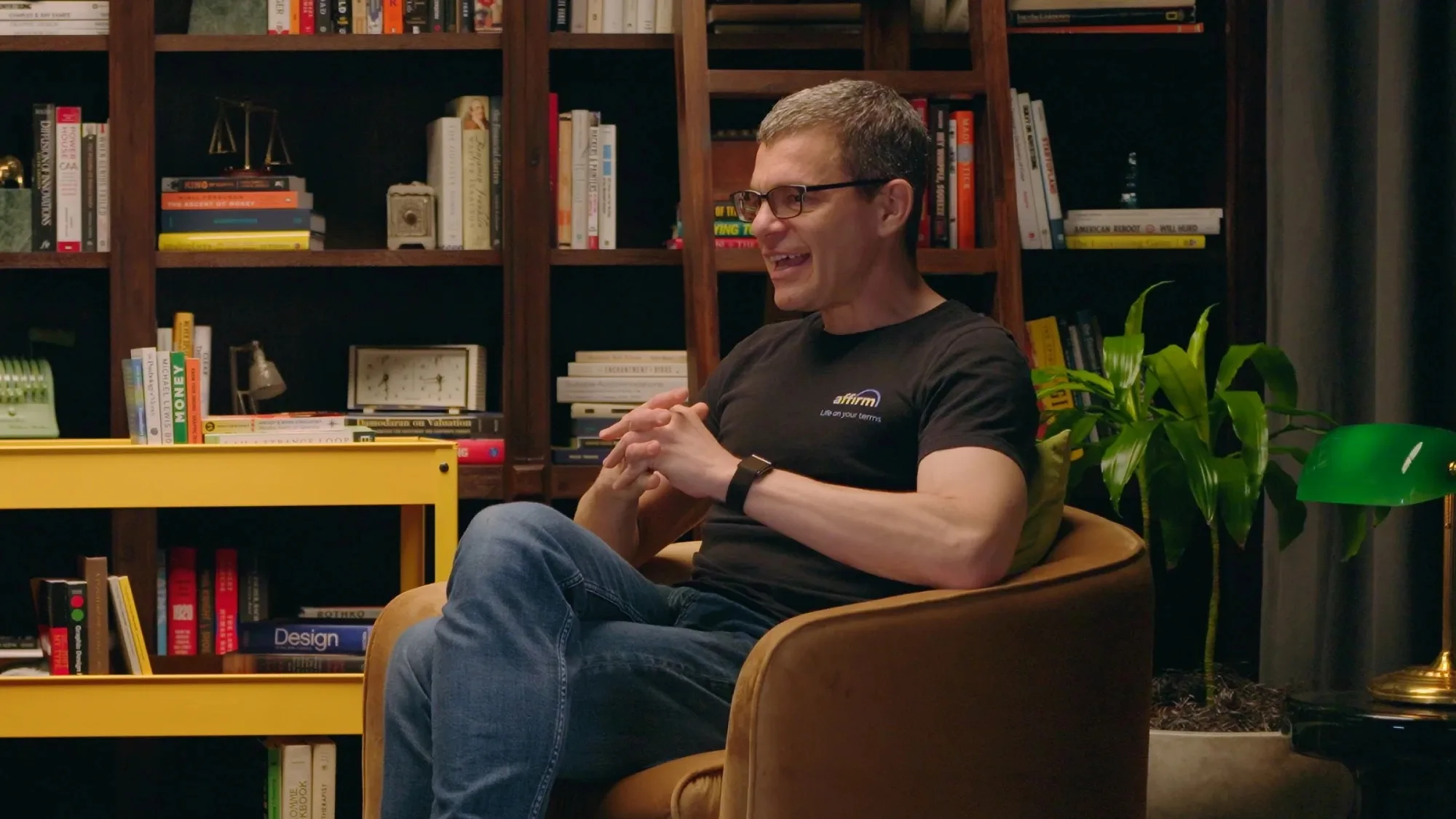
Affirm co-founder and CEO Max Levchin joins Plaid’s Zach Perret.
Max Levchin
How can we make the product that just completely obliterates this whole nasty yuck part where everybody understands you're getting screwed, including you, you just don't know how, and clean it up and make it transparent to the point where it is better than a credit card?
Narrator
Max Levchin took out his first credit card as a college freshman for a free t-shirt. It trashed his credit. Years later, he started Affirm, a lending company that has never charged a late fee. Welcome to Intelligent Finance, a Plaid podcast with the people building the financial products you use every day. Plaid CEO Zach Perret sits down with Affirm founder and CEO Max Levchin to talk about how Affirm makes 0% loans work and how AI is changing who gets approved. Here's Zach and Max.
Zach Perret
Thank you for being here, Max.
Max Levchin
Pleasure.
Zach Perret
Thank you for, for many years of partnership and building a really wonderful product. You were born in Kyiv and became a programmer at quite an early age, but I believe if I heard the story correctly, you learned to program, or you taught yourself to program on paper instead of actually using a computer. Is that roughly right?
Max Levchin
Yeah. Just, it wasn't that weird. It sounds like this really quaint sort of a crazy thing, but if you have access to a computer, very limited number of hours per week, but you really want to program, at some point you sort of ask the question, how do you do that without a keyboard? Just write down code. And you still have these notebooks filled with very carefully written code.
“My work at PayPal pivoted from building a thing to protecting the thing.”
Zach Perret
And what made you want to program so badly at such a young age?
Max Levchin
I originally actually got asked by my mom, who was told by her Soviet research authorities to become a programmer because that's what she needed to process a lot of data in her lab. And she was told, here's your state-assigned computer, learn how to program, report back in a week. She's like, you're a smart kid, help me out. So I was like, sure, why not? I have nothing else to do. And I was like, oh my God, it's the best thing ever. That's the only thing I'm gonna do with my life. And so I got the bug very early.
Zach Perret
Have you ever built anything with your mom?
Max Levchin
Yeah. When— it was actually pretty funny. One of the very first things she saw— so she was never into computer games, but she saw an implementation of Snake on some computer, and she was like, I want to build this myself. And it became this competition where I would build Snake, then she would build an elaborate one. But I occasionally worked on her, like, more prosaic stuff in the lab. Actually, one of the more kind of endearing, amusing realities with my mom. When we moved to the US a bunch of years later, she remained a software engineer, and I'd be, like, in the middle of some PayPal IPO prep, or even, like, later years, some Affirm product meeting, and she'd be like, hey, hey, I need you to call me. Like, what's up? Trying to debug this query. She did a lot of database work, like, really elaborate left outer join. I just can't make sense of it. Like, all right, hang on, everybody. I gotta help my mom do some code. It's delightful.
Zach Perret
Mother and son pair programming. Yeah. That's pretty fun. So you moved to the US at what age?
Max Levchin
16.
Zach Perret
16. A lot of people have these amazing life missions and life stories that when you actually go back to the very early days, it turns out there were like some handful of things that kind of inspired it in one sense or another. Oftentimes you can draw the lines in reverse, but you can't necessarily draw them looking forward. One of them, I think, for you was getting a credit card when you were— was it in high school or in college?
Max Levchin
College.
Zach Perret
Tell us about that.
Max Levchin
I was— I see it like it happened today. I was walking through Champaign-Urbana, and I had not had any credit cards up until that point because I was only 2 years off the boat, just got to freshman year at U of I, and there are credit cards being pushed right there from a table on campus and a free t-shirt.
Zach Perret
I remember this is how I got t-shirts and snacks in college.
Max Levchin
Yeah. So you sign up for a credit card and you get t-shirts. And so I was like, well, I need a t-shirt, and I think I need a credit card. And the credit card was really just too good to be true. It was 0% financing, and for some 12 months or whatever. And I'm not gonna shame the bank that gave it to me, but you've heard of it, so it wasn't like a completely unknown bank either. So I got this credit card, and then soon thereafter I started my first company, which had nothing to do with payments, but feeding myself became an important problem. And a startup at that time was certainly making no money whatsoever. And so I was living initially entirely out of this credit card. And then over time, some of my business expenses were being covered by this very credit card. And everything worked beautifully except for the fact that I didn't realize there was this minimum payment thing. Didn't read the fine print and hadn't been in the US long enough. And so some number of months later, I got this very angry call from a collector explaining to me how I owed a ton of money. And I was like, oh, I didn't realize I was supposed to, like, make payments on your schedule. I just thought, like, at some point I'm gonna make payments. I learned that. But when I look back, I realized that not only did I completely mess up this sort of minimum payment thing, my credit score was trashed because I was 90 days past due on the first transaction. So I was, like, full on in the dangerously close to a write-off territory. And because the credit card was what's called deferred interest, where it wasn't actually a 0% credit card, it was a credit card that took no interest from you so long as you were exactly on time with some number of conditions, which I, of course, wasn't, because I wasn't paying attention. So not only— to add insult to injury, I was suddenly in quite a lot of debt, which I vaguely understood, but also it was a lot more than I expected, because interest compounded from the moment I swiped that card, and it was getting expensive to run a company. And I basically was unable to borrow a penny anywhere else anymore, because my credit score was—
Zach Perret
Terrible.
Max Levchin
Promptly in the high 500s. And so I was suddenly very exposed financially, barely aware what the hell happened. So that definitely stays with you.
Zach Perret
And the startup that you were working on, was that the precursor to PayPal or something else?
Max Levchin
No, that was T-minus 3, relatively speaking.
Zach Perret
T-minus 3. OK, what was T-minus 3? What was the idea?
Max Levchin
The very first startup was called SponsorNet New Media, and we were building the world's first web advertising network. Sounds quaint, but it was in fact the world's first web advertising network.
Zach Perret
At the time, yeah. Amazing. Okay, so you clear the threshold and what comes next?
Max Levchin
I packed up my stuff into a truck, drove cross-country, moved in with one of my earlier failed startup co-founders, slept on his floor and concocted ideas for starting companies, and then met this guy Peter Thiel and started a company with him.
Zach Perret
And that is a story that's been very, very well covered, but maybe just give us Like a couple of the high-level points, especially as they relate to some of the things that you're thinking about now. So like you did a lot of work with risk, for example.
Max Levchin
Yeah. So obviously the initial idea for PayPal was not PayPal. It was actually— so my focus in college, had I stayed, would certainly have been cryptography and even broader number theory, sort of my first and major love, which recurs throughout my life different ways. As I was sort of thinking through application of number theory, in particular crypto, I really wanted to build— again, this is like mid-late '90s, so none of this exists yet, but we're just starting handheld device revolution and we're storing fairly sensitive documents in these handheld devices like Palm Pilots and Newtons even, and no one encrypts anything. It's like, well, as a security guy, how will I possibly let this happen? So I wanted to start a company that would help you encrypt your proprietary documents on your handheld devices. That's what I pitched Peter, who was the first backer and then soon thereafter first CEO of the company, which eventually became PayPal, as we realized that nobody actually cares about encrypting any of this stuff on a handheld, but people do want to accept credit cards online. And from a demo that I built, it gets attention of a bunch of eBay sellers and PayPal becomes PayPal. But as we got going on that, because I had no background in credit cards online or credit cards anywhere. Vividly remember being asked by one of our future investors, so what are you going to do about chargebacks? And I was like, oh. They're like, oh, you have no idea what that means, do you? Of course I'll look it up. And so I was like, no, I really don't, but we'll figure it out. And so fast forward a year and we're losing like $10 million a month to fraud of various kinds. And so my work at PayPal pivoted from building a thing to protecting the thing. And I spent a lot of my time initially building kind of very basic systems to combat fraud and manage risk. And then over time realized that actually background in number theory lends itself nicely to machine learning. And so I recruited a fairly sizable team of really, really good machine learning folks, primarily out of Stanford, but also some U of I people actually. And we built—
Zach Perret
Stanford.
Max Levchin
The very beginnings of what became foundational PayPal technology around detecting large-scale distributed fraud, preventing people from what's called scalable fraud where you can script or programmatize attacks. And so all of that these days is kind of a baseline, like you do it, we do it, everybody has to. In '99, 2000, it was sort of like, whoa, you know, I remember showing this to law enforcement folks and they're like, this is amazing, like this takes us days to manually cross-reference on paper. I was like, I don't know how you do that. We have a million users, which seems quaint and tidy, but they're like, oh, we do this with tens of perps, and we're barely keeping up. So it was— those were fun days.
Zach Perret
Just drilling a little deeper, how did you see so much fraud? Was it organized rings? Was it just individuals?
Max Levchin
It was largely organized crime. I mean, fraud changes, but it kind of also stays the same. There's always some form of people that steal credentials and try to bilk them for stored funds or funds they can borrow. This was also fairly early in online security.
Zach Perret
This is when it was barely safe to put your credit card in online.
Max Levchin
It was not safe. So people just wouldn't encrypt it. And so people would just like congregate in these online forums and you had to like know someone who knew someone to get yourself an account. But I signed up for these forums and I would watch people talk about like, oh, you know, I just got myself 100,000 credit cards. I need to test them. And like, cool. Go sign up for PayPal. They accept credit cards. And like, just like try, you know, and set up a fake eBay seller and just like get some money. And so that's an attack vector, which none of this is now possible, so these are all fun and games now, but back then it was enormous. A lot of it came from Eastern Europe, which I had a secret advantage. I spoke at least a handful of, or read fluently a handful of Eastern European languages, so I would lurk on these forums.
Zach Perret
How funny, how funny. Okay, we're gonna fast forward through some things. You left kind of shortly after the acquisition. You then, Launched a company called Slide, and that sold to Google. You also were around, or maybe even a part of the launching of Yelp, and were closely with them. And then you started a kind of a venture incubator. Is that what it was? It was HVF, is that correct? What does HVF stand for?
Max Levchin
It stands for Hard, Valuable, Fun.
Zach Perret
Okay.
Max Levchin
And actually, it was a second incubator. So I started another one. That's where Yelp came from, and Slide, and a couple other things. And the lesson from Slide was, it was a pretty hard project. So we built a very large social media kind of experiment, for lack of a better term. It was hard to build, took a long time. It was actually fairly valuable at its peak, and obviously sold for a bunch of money to Google. But weirdly enough, despite being a social media and sort of a gaming-oriented social media, it was actually not a lot of fun for me. Hmm. And it sort of, it caused me to reflect pretty deeply Seriously, like, why did I not enjoy myself nearly as much building essentially, for lack of a better term, a games company, which it should be a lot of fun, while I couldn't remember anything but sort of extremely fond memories from PayPal, which was basically a bunch of fraud fighting and like trying to outsmart the bad guys and all of that. And so ended up going through this long reflection period of, by long I mean like a month, like what's fun for Max? And it turned out that actually building financial systems is probably more fun than just about anything else for me, which is how I ended up doing Affirm.
Zach Perret
Okay, and so Affirm, how did you come up with the idea for it? I know that you'd done a lot of things that were similar before, but talk to me about, like, the very beginning stages of it.
Max Levchin
Like everything else, these things have a neat origin story, but in reality always have kind of a jagged edge of, you know, how did you actually get there? So one of my Affirm co-founders, but also a longtime co-conspirator at PayPal, and before and after, this guy Nathan, we kept on talking about, well, what else, like, hearkening back to the happier days of PayPal, the question we kept on trying to find an answer to, why didn't we try to go below the rail? So the proverbial rail is the credit card networks or, you know, the NACHA protocol. Why did we not go as far as taking the risk on the actual quality of the funds? We relied on bank accounts telling us the funds are good or credit cards telling us the funds are good, debit card networks, but we never actually lended money ourselves. And I didn't really have a great answer. So like, it seems like just not a thing PayPal was going to do. Like, we had our ACH arb, it was fine. And we kept coming back to like, well, so is that because we couldn't stomach the risk or because we just didn't think of this? And we both agreed that probably just didn't think of it. Like, we could build a model to underwrite transactions and actually take the full principal risk on the amount. That sort of was the thread we pulled on enough to like, why don't we build something? And so Nathan eventually dropped out of Palantir to help me start Affirm to find out if we can build an underwriting model. The original theory was very, very simple as, of course, we knew about FICO. We thought FICO quite a capable model. It's like, well, can we do better? And so we built a version of an underwriting model primarily scoring the quality of the consumer to decide and test, backtested against some data we had access to, and like, eh, seems like we could actually do better than FICO. So we sort of promptly started asking ourselves, well, how do we get this deployed? Like, we have a thing that's better than the best publicly used score. And so we went to see some people in the lending world that we knew from past lives, and they all said, like, we're not going to lend money against your model. Like, you think your model is so good, you lend your own damn money. Okay. It's like telling entrepreneurs what not to do. What do you think is going to happen? So we then started to— so should we launch our own company? competitor to a Lending Club or something where, like, you know, loans are the currency. And both of us were like, neither one of us is a marketer. Like, we wouldn't know how to— like, standing on a street corner waving a flag saying, please borrow money from me, we're obviously going to get the worst adverse selection possible. That's not the way. So what is the way? Spent a fair amount of time talking about that. And then I somehow chanced on a report, sort of 2 different reports actually. One of them was extolling the virtue of point-of-sale issued cards. So these are the cards you go to your favorite department store, they tell you if you get this card, it's 0%, and you're like, I've seen this before, 0%, and for 9 or 18 months or whatever, you can buy whatever you want so long as you make this precisely articulated schedule.
Zach Perret
And 2% off of whatever you buy.
Max Levchin
Exactly, that's right, and free pants. And so I was like, I've seen this before, that's the thing that trashed my credit score 15 years ago. And so it sort of all came back rushing, like, ah, I hate these cards. But the report said this is the fastest growing type of credit card. And reason being, it's the retailer doing the marketing. There's no marketing involved. It's their customer, your underwriting, your capital, their discount rates.
Zach Perret
So you're standing in a JCPenney store. Yeah. The person across the register says, hey, would you like to apply for a credit card? You get $50 off or $5 off or whatever it is.
Max Levchin
Exactly.
Zach Perret
Okay. Cheap marketing.
Max Levchin
Yeah. And so, like, this is our in. So if we have— if we think we have a better credit score, We should just build our own version of this thing. And the more I looked at it, the more I sort of realized that this is actually a pretty great marketing approach, but it also unearthed all of my, I feel so screwed by this product. Like, I'm a, you know, barely 20-year-old kid trying to start a company, and now I feel like I trusted someone, you know, for a t-shirt and a credit card. Like, it's ruined what I thought was my future forever if there's no credit cards or any other kinds of credit access in the future. So I'd sort of gone from, we should build a better score and flex our big math brains, to, we should do something about these cards that don't tell you everything, or at least tell it to you in a way that you cannot fully understand, only to then find yourself in debt and on the floor and getting kicked while you're down. So that sort of shaped the original idea. sort of foundation stones of the mission.
Zach Perret
And so you have this idea, you've built a better FICO, you've decided that you don't want to go B2B with it, or it's too hard to go B2B with it, so you decide to go direct-to-consumer with it, but via these merchants. How do you get a merchant to actually do it?
Max Levchin
It's pretty hard, but I had this other co-founder, Alex Rampell, who is now a partner at Andreessen Horowitz. He ran a payments company most recently of all of us, And he was like, I'm sure I'll find a merchant. And so not only did he find a merchant, which was 1-800-Flowers, which is kind of a random merchant, except if you know Jim McCann, who founded 1-800-Flowers, he's the world's most enthusiastic person ever. So if you just happen to talk to him, and you're Alex Rampell, who's a great salesman, and not a bad software engineer, so he put together what was— prototype is a strong word for a demo-ish thing that he threw together, but he was able to show it to Jim, who was like, Oh my God, best thing ever! Of course, people used to call us on the phone back in 1-800-Flowers days, and We would just tell them, sure, we'll ship you the flowers, and you can pay us later, 'cause, you know, your anniversary's too important. Yeah. So he understood intuitively this idea of, like, buy now, pay later, as the industry became known. And more importantly, he was like, sure, I'd love to give you guys a try. Like, why not? Do you wanna take the risk? Go for it. So 1-800-Flowers was our first merchant integration, which ran into a million bumps along the way, but it was just enough to get, like, 2 other merchants to pay attention, like, Oh, that's kind of an interesting idea. One of them did a pretty good job integrating us, and when that happened, the CEO called me and said, I don't know what you guys did, but I saw a 30% increase in my top line. And so, like, whatever it is you got, grab the tail, 'cause you have a real tiger here. And I was like, I don't know what it is. And my first reaction, of course, was, oh my God, the underwriting model must be letting everyone through or something. Just clearly like this—
Zach Perret
You have a fraud problem.
Max Levchin
Yeah, I have a fraud problem or an underwriting problem.
Zach Perret
Yeah.
Max Levchin
It was not. It was actually just the right intersection of a high-quality— so it was a fairly expensive set of items. The consumer was—
Zach Perret
What retailer was it?
Max Levchin
This, the one I have in mind was called Tradesy, which was a secondhand, but sort of upper tier, like sort of The RealReal, but slightly earlier than The RealReal. And Tradesy was the name of the site. And literally Tracy, the woman who happens to be, happens to be the CEO, sent me a screenshot of her dashboard showing like pre-Affirm, post-Affirm. I was like, okay, whatever it is, the value here is we are driving real volume to this retailer. We just have to do it for a million other retailers, and we got an amazing company out of it, and so that was the—
Zach Perret
That's what you did.
Max Levchin
That's the moment.
Zach Perret
So you originally talked about cards, replacing that kind of store-issued card, but what you ended up with was a, Buy now, pay later, similar concepts, but how did you make the switch?
Max Levchin
So as I started sort of unpacking both, like, what's so pernicious about these deferred interest credit cards and, like, what do you do about it? So the idea of you're standing at a retailer and you're looking at a pair of pants and a pair of shoes and you want both, but you can only afford one. And so there is a credit product available to you so you don't have to compromise is a good idea. Like, there's nothing wrong with it. You know, you can sort of judge people for borrowing money or decide that's what America is built on. But the notion of I need both and I have money for one, the resolution is either, well, go barefoot or underpants only. But you're going to need to borrow money to afford that. And it is not a bad thing. In fact, that's how we fuel our economy here. The downside is, of course, you're also vulnerable. You have someone who's selling you an instrument that could absolutely overcharge you, hide a bunch of fees, create this hidden interest lever that you don't understand until it's too late, which is what happened to me. And so I basically thought to myself, what if we took all the good, this moment of like, I need both and I need to have access to credits, and if you can pay us back, if the underwriting model actually does work as well as we think it will, how can we make the product that just completely obliterates this whole nasty yuck part where— everybody understands they're getting screwed, including you, you just don't know how, and clean it up and make it transparent to the point where it is better than a credit card. And the bet I made was one of the things that I thought would happen is if you had a total grasp of not just that you're borrowing money and it's transparent, you understand the terms and all of that, but you also had a full mental binding between the item and the loan, the actual moment of borrowing, you would be not just more likely to pay it back, because you've had a clear sense, like, well, this bill is for the pants and the shoes, versus credit cards, which is like, well, make a minimum payment, and there's some coffee in there, but also maybe the pants. And so this decision to separate out each transaction into its own mental space was important to me, because it allowed me to articulate the true price for every item, Hmm. but also because I thought it would help repayment metrics be better because you would associate the repayment flow with a specific item that you were using.
Zach Perret
That's a cool concept. So you said you built a scoring model that was better than FICO. What were your data inputs at the time? Because I'm sure they've become much more sophisticated since then, but, you know, it must have been hard to get the data that you needed early on.
Max Levchin
Early on, we basically said we want to look at credit bureau data because that's where everybody dumps whatever they know about this consumer. But the incremental alpha we were hoping for and got was from the merchants. So if we knew that this transaction is for these jeans, maybe there's enough signal to say blue jeans are less likely to be default-prone than bright red jeans. And again, like, none of these things unfortunately work quite as simply as that. But for example, I mean, everybody knows that red cars get into more accidents. Like, who knows whether it's apocryphal or not, but that's a useful illustration. So there's some information value inside, or at least maybe get more tickets. I think that's the apocryphal version.
Zach Perret
Speeding tickets.
Max Levchin
Well, you know, if you buy a red car, like, you might as well. But the point is there's information value in information that isn't captured on a per-transaction basis by credit cards, by credit card networks. So Visa, MasterCard, Amex famously don't transmit SKU-level data. They just transmit the total. And so my theory was, what if we actually asked the merchant for that data? Perhaps we could find a little bit more alpha for the model, and then we would approve deeper. So we wouldn't keep the spread for ourselves, we would just give loans to more people. And that's been guiding light for Affirm since day one. Anytime we find a pocket of margin opportunity, we turn it into more approvals.
Zach Perret
That's amazing. And you all have done a lot of very pro-consumer things. So relative to past lenders, there are no late fees, it's very transparent, Talk to me about the kind of consumer experience that you started with and that you've really kind of endeavored to build over many years.
Max Levchin
So the idea of transparency was super important. There was actually quite a lot of thought that went into sort of why and how. One big part of it was actually talent acquisition. So as I was starting to build a team, I realized that if you wanted the absolute brightest people in machine learning and sort of thereabouts, it would be very hard to persuade them to go work on a schlocky piece of consumer finance. Right. And so not just— I didn't want to sort of relive, or I didn't want anyone else to relive the deferred interest experience that I had. Like, well, what if we elevate it to the point where it is the best, most transparent, least confusing, most simply priced, fixed priced? In fact, if you prepay, we'll refund the interest. In fact, If you see a price that we gave you, and then you take extra time, we will not compound the interest, so the price can't change. So we can say the number of dollars you'll pay is exactly the same, no matter what the— so we went through extreme lengths to do this, and part of it was so we could tell people we hired, like, these are all the things we're going to do. You're never gonna be embarrassed by the product you're working on. Yeah. And it worked really well. We got some amazing talent, a lot of it is still with us. Second part was, we knew we were competing with credit cards, and credit cards are extraordinarily beautiful in terms of user interface. Like, say what you will about all the other parts of credit cards, they are a nice user interface. Like, you tap and you go. That's it. Yep. And so long as your open-to-buy is good, you're done. And so we knew we were signing our consumers up for more work, and the exchange had to be something. And one of the things we said, well, what if we promised you, you will always know the start and end date of your loan, for every loan you take with us? The theory was, well, it's a little bit burdensome. You get like 3 emails or 5 emails or however many live transactions you have going on, but you know exactly what's going on. This sense of transparency is going to help you manage your money. That one I didn't know would work, but it turned out to be exactly right. And I think it has to do with the fact that everybody has a smartphone, so it's just a lot easier to manage these sort of many transactions versus just one balance that credit cards do. That was another major component. And part 3, and that sort of gave us a huge leg up, Back to the question of, like, how did you get these retailers to even give you the time of day? 'Cause we were certainly a startup and had nothing to say for ourselves for a long time. We would come in and say, look, we are never going to be an embarrassment. Like, we will create a brand halo for you. Like, you may not have heard of us, but how many times do you hear complaints from your consumers about returns or credit card disputes or chargebacks? We're going to lean heavily into the treat the customer so right, they love you, the retailer, because of the experience they have with us. And we've been sort of sticking to that, and so we have, and continue to have, targets for things like NPS and number of stars reviews, and we're very proud to be in a 4.9 star in every imaginable app store out there, because we're so obsessed with customer experience.
Zach Perret
So you guys got big pretty quickly, and as—
Max Levchin
Overnight success, 7 years in the making.
Zach Perret
Well, sure. But as a lender, one of the hardest things to keep up with is, like, your supply of dollars. So for example, as you grow, you need more dollars to make these loans, and then the way that you replenish those dollars is you then sell the loans on the other side, securitize them, and so forth. Talk to me about that. I think that you've been very innovative in the securitization, getting the market to trust your scores, so on and so forth. So talk to me about your supply and demand side.
Max Levchin
Appreciate the very innovative part. I think we've been more than anything relentless. So when we sort of started this thing, I did enough research to know that one of the ways to fail is you run out of lendable capital, which seems like a high-class problem, but it's still a problem. And the sort of— a version of a collapse looks something like this. You make a lot of loans, everybody's very happy, retailers promote you. For whatever reason, the capital source on the back end, whether it's a warehouse line, which most people in the lending world just initially warehouse their loans, which is fancy for borrow against the loan asset. But most importantly, if your warehouse provider says, all right, sorry, I'm just full up, I don't want to warehouse any more of your loans, you will stop cold, at which point the merchants say, wait a second, you were supposed to lend more money. I have a Christmas sale coming up. If that's not available to you, you're not available to them, you'll be kicked off the merchant's site real fast. And so from day one, our— one of our many obsessions has been, How do we make sure that we never run out of lendable capital? The most important thing I've learned on the capital markets side of this world is you can't ever have enough channels for capital supply if you're not a depository, which we're certainly not, because you just don't want to find out that someone is full up. And the way you make sure no one leaves you, which we've been extraordinarily good at keeping all of our partners very close and we've barely ever, I'm not sure I can count it, I need more than a finger to count the number of these long-term relationships that did not renew, is 2 ways. One, we've been completely obsessed with the quality of underwriting. Like, it's not an accident that people love partnering with us on the capital side. We consistently deliver the yield we said we would. So it's not enough to make a loan and sell it. Who knows what happens to it? We treat every loan, whether we keep it on our own balance sheet or sell it to someone else or securitize it or warehouse it, whatever it is, there's no difference to us in terms of how well we underwrite it, how well we service it, which we always do, how well it's seen through the entire life, because the quality of that return ensures that same loan buyer or security buyer or warehouse provider comes back for the next one. We deliberately don't take the last penny off the table every time we negotiate these lines of credit or securitizations, et cetera, to make sure that our partners know we want long-term partners. And that's worked beautifully well for us, including through some hair-raising times when the Fed decided that interest rates weren't nearly high enough and did this. And many people— That was a weird year. Yeah, it was an interesting year for all of us. We did not lose any capital markets relationships. And I think that that's a very small number of people. in the industry that could boast that.
Zach Perret
So fast forward from kind of mid-stage Affirm to now. In the past, you've talked about building the money super app and much more, and you've actually launched a bunch more products for consumers and I'm sure more for merchants and so forth. Talk to us about what the product suite looks like now and what you're excited for going forward.
Max Levchin
We're definitely pretty widely ambitious, if you will. And so we've launched initially a virtual card that to have brought Affirm connectivity to merchants that haven't yet integrated Affirm. But our consumers want to shop both places where we are integrated, where we're not. So we will— initially, we would give them a literally on-screen virtual card number. They could type it in, and the loan on their side would look like a card number to the merchant. Over time, we realized that that doesn't need to be just on the screen. In fact, it's actually very nice to have a piece of plastic that you can tap in your favorite retailer. And so we started issuing debit cards with borrowing capability, kind of It's not a credit card. It's a debit card that has the ability to sometimes borrow money. That's gone off extremely well for us. It's probably our fastest-growing product. We continue to invent new ways of essentially helping consumers buy things without having to burden them with fine print. One of our— my favorite core value of Affirm is no fine print. That sort of contains a lot of what you want to know about the company. So that's what we keep working on. We've been incubating a few more new products, but nothing to declare just yet.
Zach Perret
You've been doing AI since nobody called it AI. It's like very early machine learning. And I can imagine that many elements of machine learning have just kind of like permeated even from the early days, even talking about your PayPal experience. How has this wave of AI over the last 4 years changed your products and the company internally?
Max Levchin
There's a bunch. It sort of would take a long time to sort of describe them all. All the obvious things are obvious. So our engineers are a lot more productive. Our designers are prototyping things on their own. Our PMs can build. So it's what everybody's doing if they know what's good for them. The more interesting thing we've done is when we saw— so we're obviously always chasing the latest, greatest, interesting idea in modeling. So AI, ML, there's a lot of acronyms. The question we're answering is what are the odds that this particular person for this particular item at this particular moment will pay their plan on time to us. And that's a very complicated prediction puzzle, and we're really good at solving it. But if there's a new way of modeling future, or at least trying to predict the future, we'll gladly try it. And so when we saw the original work around LLMs, the first thing that we thought was like, ooh, can we express sequence of financing financial events as a language? Because if we can, we should be able to predict the next token. And so we built and we spent 3 years building, testing, and now finally, literally a few weeks ago, deployed a model that is transformer-based. So it looks a lot like LLM on the inside that uses credit events and financial, broadly speaking, events to help us underwrite. And it's a pretty amazing accomplishment in a sense that not only is it significantly more performant than our initial, or in now many, many generations in tree-based models, it is also 100% explainable and repeatable. In other words, when someone challenges the outcome, be it a regulator or a consumer saying, why did I get declined? We can actually provide a full set of answers, unlike, you know, in other words, it doesn't hallucinate, which is not an easy task. And so we're able to both get a significant underwriting boost and keep it at an explainable and replayable level.
Zach Perret
So one of the things that we do at Plaid is we read a lot of books, as you can tell by the set that we've created here. And we asked you before to bring a book recommendation of a book that has influenced you in some important way. So will you tell us what that is?
Max Levchin
Sure. Happens to be right here, in a strange way. This is definitely not a book most of your listeners have heard of. It's called Monday Starts on Saturday. It's a great book. It's a great book for 2 reasons. It's a book from the '60s, so clearly many, many scientific revolutions ago, and yet it is still current. It's basically a story of a young idealistic software engineer that joins a research facility somewhere in a Siberian forest that studies magic. Mm-hmm. And magic is being treated as a real science, and there are experiments, there are sort of Their A/B tests, their labs, their, you know, all the things that you expect in a kind of a physics research facility or chemistry research facility, they do it with magic. And it's sort of, everybody understands that that's just what happens and that that's what they do. So it's sci-fi but a little bit fantasy, but more than anything, it's about loving your work. The idea of A Monday Starts on Saturday is this notion that there's a scene in a book where the main character gets bored at a Christmas party, and he sort of meanders, and he doesn't really want to drink another punch, and just kind of runs into some people he knows from the town, but doesn't see any of his colleagues and wonders where they are. Maybe they're drinking at some other party. And he finally kind of makes his way back to his lab. And it turns out that every one of his peers is slowly meandering back to the lab and setting up another experiment. And he's like, are we that boring of a species here? And one of his friends says, no, Monday starts on Saturday. Like, you just— if you love what you do, That's where you end up, like, even on a Christmas Eve. And it always stuck with me as— I mean, it's super idealistic. It's the sort of the physicist versus the lyricist debate from the '60s that played out concurrently both behind the Iron Curtain and in the US. But it's just a— it's a sweet reminder that if you love your work, you end up with these archetypical, independent of the native language, types that just want to do the next best idea, even if it's not the right time of the day or, you know, there are other obligations. I always recommend it to affirmers who want a happy book. The other reason why it's a great book is because I think a lot of what we're living through in this AI moment is kind of like literally in our time, we're seeing science fiction just become real. Yeah. I grew up watching Blade Runner where Deckard talks to a computer, That would never happen. I'm a CS major. You don't talk to a computer. I can barely click on a computer. You can absolutely talk to a computer. Talk to a phone, and it works. And so as we sort of see the white spaces of science fiction, impossible but not anymore, filled in, I always look for interesting bits of sci-fi that others have overlooked, sometimes for ideas, but also just to know what might happen that others aren't thinking about. And there's a particularly quirky book. You can find a lot of things that others are not talking about. Well,
Zach Perret
thank you. Thank you for the conversation. I'm excited to read the book. And thank you for being a partner for many years.
Max Levchin
Thank you.
Narrator
That was Max Levchin, founder and CEO of Affirm, with Plaid co-founder and CEO Zach Perret. New episodes of Intelligent Finance are coming soon. Follow wherever you get your podcasts or subscribe on YouTube. Thanks for watching.