
A Tale of Two Banks
Chime changed banking for millions. What happens when AI changes it again?
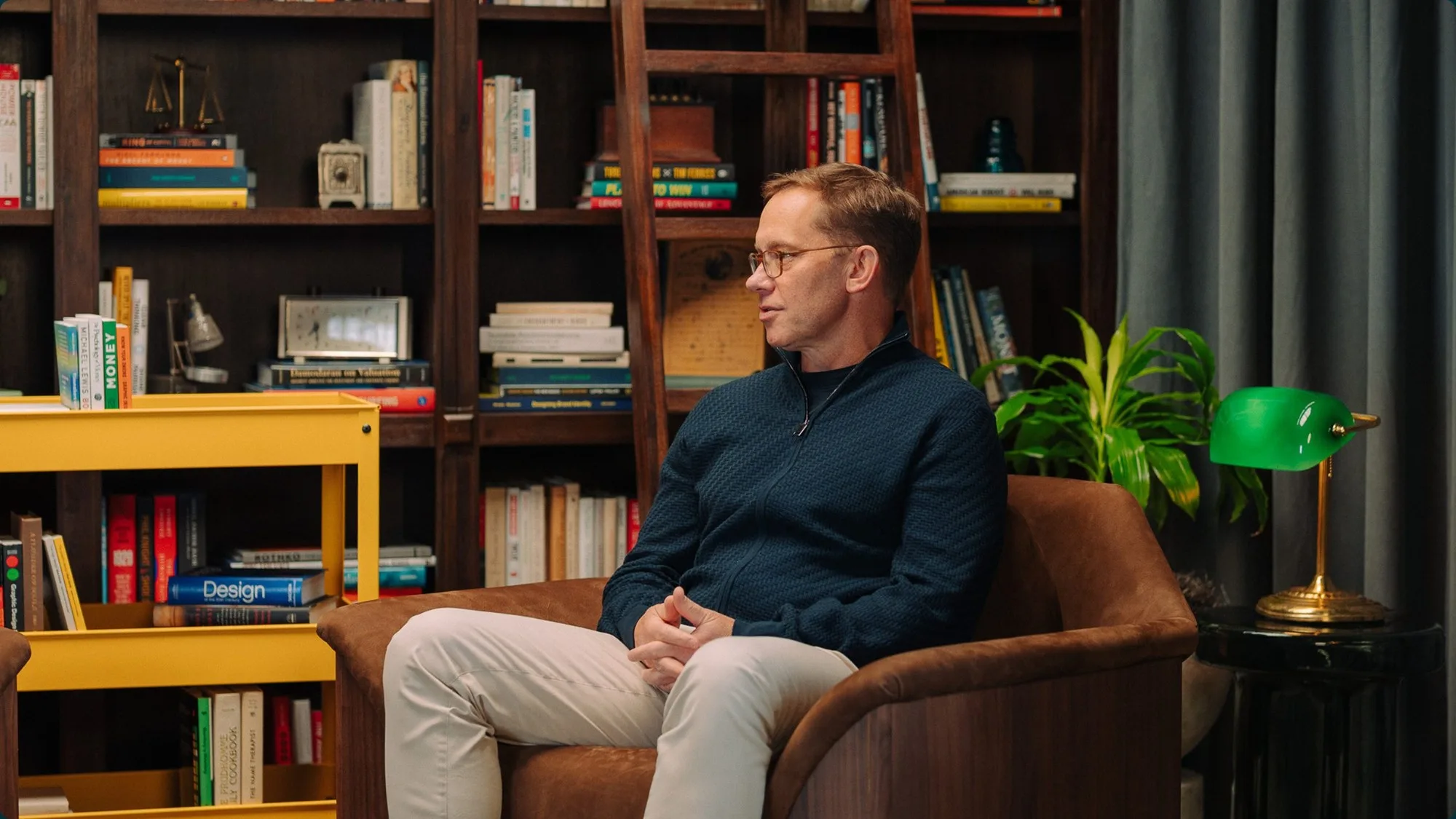
Chime co-founder and CEO Chris Britt joins Plaid’s Zach Perret to talk about challenging
traditional banking, earning customers’ trust, and how AI could shape what’s next.
Zach Perret
So a fully automated financial advisor who you can just give the keys to certain parts of your financial life, it'll do it for you and it'll tell you when you need to take action.
Chris Britt
Keep you, bring you along though, right? Like make sure that before it takes action, maybe says, you know, hey Zach, I'm gonna do this, here's why. And then you say, yeah. I think it's gonna be a really exciting few years as that starts to come together.
Zach Perret
I'm excited. Put me in the beta.
Chris Britt
Yeah, I'd love to.
Narrator
Chime founder and CEO Chris Britt built his company on one idea, a bank account without the fees. 14 years later, Chime has more than 10 million members and is betting AI can do more with your money. Welcome to Intelligent Finance, a Plaid podcast with the people building financial products you use every day. Plaid co-founder and CEO Zach Perret talks with Chris about how banks with no fees make money and what changes when AI starts handling your money for you. Here's Zach and Chris.
“What if there was a bank for regular people that didn’t charge any fees?”
Zach Perret
Chris, thank you for being here. Inaugural episode of Intelligent Finance. It's been amazing to know you for a long time, be inspired by your story for, for so many years, and now finally get to do this. So thank you for being here.
Chris Britt
Thanks for having me. I think it's awesome that you're pulling this together. So excited to have a conversation with you.
Zach Perret
We'll see where it goes.
Chris Britt
Yeah.
Zach Perret
One of the things that I found is that people's personal missions are often tied back to, like, some portion of their history. Also, in thinking about it for myself and for others, you can almost never tell the story linearly. You kind of have to look backwards. Tell me about childhood. Like, how did, how did those experiences shape Chime eventually?
Chris Britt
Well, I am the third kid of amazing parents, but they got divorced when I was 4, I believe. So as the third kid, you end up with a pretty independent streak about you. And I think that's really served me well. I didn't have— you hear about and you see these parents, they're doting over their kids' every move, and I certainly didn't have that. Loving parents, but I think at a very early age that I developed a good amount of grit and agency and was shoveling snow, delivering newspapers, working at Baskin-Robbins, you name it. And yeah, I grew up in a pretty gritty town just outside of the Bronx in an apartment with my mom and 2 older siblings who I still am very close with. I had an amazing childhood, but definitely, you know, sort of grounded in the real world outside of the bubble of Silicon Valley. And I think that that's obviously a core to my DNA now, and I think has probably helped to serve as a superpower in terms of designing and delivering services for mainstream America.
Zach Perret
So, like, talking about the kind of grittier upbringing, kind of the real America upbringing, you've worked on a bunch of products that have kind of addressed that population. I mean, Green Dot maybe most obviously, and then Chime, of course. addressing kind of the broader population of the US. Tell me a little bit about that story. Like, first, how did you get into financial services? Like, why was that even a field you wanted to go into? And then kind of how did those previous experiences shape Chime?
Chris Britt
Well, I made the jump out to Silicon Valley in the late '90s when the first internet boom was happening. And I worked at a few online advertising companies that had some success, not as a founder, but I really enjoyed working with, you know, small, tight-knit teams that wanted to disrupt large industries and had some success. Eventually made the jump over to Visa where I helped to launch a new line of business for them. And that really got me into the depths of payment systems and processing platforms and bank partnerships. I ultimately joined Green Dot as the Chief Product Officer for the company in advance of their IPO. And we had a lot of success, you know, really focused on serving the needs of pretty low-income consumers, a lot of, you know, Walmart shoppers and wonderful people. Really could feel the power of distribution was something that I definitely learned from that experience. Green Dot was able to negotiate distribution partnerships with, you know, 50,000, 75,000 retail locations all across the country, and that was really, really powerful. I think that— I don't want to say a miss, but let me say the opportunity that I thought maybe we didn't fully achieve was the ability to serve mainstream America with a full-featured bank account that just worked better than incumbents as opposed to a prepaid card or a set of services that felt like, you know, almost like a second-class service if you couldn't get the main product. So that was the opportunity that I wanted to seize coming out of that opportunity.
Zach Perret
And was that with the intent of, all right, I'm done here, I'm going to go found a company, or kind of off on an exploration quest?
Chris Britt
I knew I wanted to found a company, and my wife Alex really encouraged me to do it as well. Now the hiccup was that our son was being born. I strategically waited a few months to leave the company until after that event happened, and then a couple months later I founded Chime. It wasn't called Chime at the time, but founded the company just a couple months after he was born, which is kind of cool because he is like literally the physical embodiment of the company.
Zach Perret
That's not the typical story of the Silicon Valley founder, like the college dropout who started a company at 20. You had an amazing career first. And then we're having a kid, and like, if I could think of all of the times in life where taking a gigantic risk made sense, having a kid's not usually the expected timing.
Chris Britt
Agreed. I was in my late 30s, which in this day and age I guess is pretty late to be a founder, but there are a lot of successful founders in their 30s and 40s. Interestingly, my co-founder Ryan was in a similar life stage as well, so we both had— we had both had some success professionally, and we both had kids that were very young, and we could all hang out and celebrate the highs of fundraising success and commiserate the lows, which happened quite a bit as well in the early days, like, like so many companies have to deal with.
Zach Perret
Who was your customer at first? Was it, was it just a continuation of some element of the Green Dot story, but the gap that you saw in the market? So it was the same customer you're going after there, or a fundamentally different customer?
Chris Britt
No, I would say it was different. It was a different consumer. We weren't trying to bank the unbanked. Our mission from the earliest days was that the relationship that so many consumers have with their banks was broken. And there are a very, you know, what we wouldn't call unbanked, but the unhappily banked. Having, you know, grown up in an area where a lot of people, you could see people suffering with their finances and so many people living paycheck to paycheck, these aren't unbanked people. These are These are regular people that are, you know, police officers and nurses or security or, you know, entry-level and even mid-level employees at big corporations. That's who we wanted to serve. I remember, you know, in the early days of going out to raise money, part of my pitch was I would just print out the statement of one of the, you know, fee schedule of one of the big banks, and it's literally, you know, like a half inch thick of all the potential ways that you could incur a fee. And our pitch to the investors was, hey, what if there was a bank for regular people that didn't charge any fees? Do you think that could scale up in a world where you now had unlimited distribution because of the App Store as opposed to having to go through physical branches or retail stores? We showed the low NPS and everything that— and how dissatisfied most of America was with their bank, and that was kind of the business plan from the earliest days. and remains pretty consistent to where we are today. You know, the first few years wasn't exactly, you know, fully up and to the right, but we kept hitting our milestones and making progress. It took a little bit, but we eventually nailed the formula.
Zach Perret
Well, what was the— like, tell me about the initial launch. Like, I'm sure you had huge expectations, and then you said it wasn't all up and to the right. Was there a change in direction in there?
Chris Britt
Yeah, you know, we wanted to have people use Chime as the primary bank account, but we figured we needed some clever approach to reel people in. And so we had a very heavy rewards focus out of the gate.
Zach Perret
What kind of rewards?
Chris Britt
Well, Ryan had built this amazing tech where we would basically— we mapped out major merchants in America looking at the auth code that comes through the MCC, you know, the MCC code that comes through the transaction. And we literally were able to insert real-time rewards into a transaction based on, you know, if you— like we did a little deal with Sephora. And if you swiped your Chime card at Sephora, we would instantly put a few dollars of credit into the transaction. So it was, yeah, and it was really slick and all real time. And you could like turn on the deals on your phone. And it was pretty successful. It had some really good traction out of the gate. What we found was that after we signed all these people up and we got them using the rewards and they were saving at, you know, Abercrombie & Fitch and Sephora and all these places, we said, hey, it seems like you really like Chime. Why don't you use us as a primary bank account? And the number one, and set up direct deposit. which was always the goal. And the number one answer was, oh, I didn't know you could do direct deposit to a Chime account. And we were like, oh my God, what are we doing? We were being a little too cute. Yeah. And we basically decided to pivot the positioning of the company and just say, you know what, if we think we have the best banking solution for mainstream America, let's just say it. Let's just be straight on. Like, we're better banking than fill in the blank big bank out there. Yeah. Because we don't charge fees. We give you access to your pay early and eventually added a whole host of other services like SpotMe, which lets you take the account negative for free and address a lot of those pain points that so many people were suffering from in our country. Having been in payments and financial services for a long period of time, that the holy grail in financial services, you want to own the primary account relationship. And if I look back over the past 14 years now, that's what we've done. more successfully than I think any of our sort of core competitors and why we're now, you know, really head-on competing with the big banks for those primary account relationships, which is where most, most of them exist today.
Zach Perret
Yeah. So there are 2 huge themes of Chime that at least stand out to me. One is like building the right product and the right set of features at the right time for your customers. I want to talk about that. The second is like your marketing strategy, your customer acquisition strategy. So maybe just starting on the product side, like, you have this series of products that seems to, like, hit, hit the stride of exactly what your customers were looking for at the time they were looking for it. So, like, your pay advance stuff, SpotMe, I mean, a handful of more recent products as well.
Chris Britt
You know, when we invented getting paid 2 days early to a checking account, like, who would have known that pretty much any bank ad you see in America today touts that. Okay. And, you know, the banks, the larger banks eventually catch up, and they— but, you know, the amount of time that we have by the time they roll that feature out, like, we're already 2 or 3 features ahead. And yeah, it's been a lot about avoiding fees, getting access to liquidity, building credit. You know, some of these things people think are like low market, you know, for people really like down market. It's absolutely not. Regular, every— everyday people want to improve their credit scores so they have a better chance of qualifying for a mortgage or an auto loan. This is a very, like, sort of mainstream set of needs that I think have been largely overlooked by a lot of incumbents that really are focused on whales. The whales in terms of the corporations they bank or the higher net worth super prime people that they design all their credit card programs for. And their structure requires them to focus on serving their needs, whereas, you know, because we don't have physical branches and we build everything on modern tech, we're able to serve regular sort of everyday consumers in a way that's highly profitable without having to rely on fees. So it's a great business model, and it feels like in some ways it's not a fair fight because we just foundationally have a better cost structural advantage that is really quite different than incumbents.
Zach Perret
I'd love to go through some of the features, if that's okay.
Chris Britt
Sure.
Zach Perret
So you built a product that lets you get paid 2 days earlier as a customer. How do you do that? How do you even know what information is coming in?
Chris Britt
Well, when payments— when you get paid on Friday or whenever you're— every 2 weeks or at the end of the month, whatever it is, what happens is the NACHA system, the ACH system, which is how most money moves in America, typically sends a file A pre-notification to a bank that money is going to be received. So our hack on that was like, hey, if I— if your bank— Zach's banking with us and we get a notification or our bank partner gets a notification that you're going to get $3,000 on Friday, we just make it available as soon as we get the pre-notification. So we actually don't have the money yet. We make the money available. That turned out to be a huge win for us. It's a huge win.
Zach Perret
And it seems— I mean, in retrospect, seems obvious, but every bank in the US was getting that same pre-notification just—
Chris Britt
And people wondered if there was risk. There's no risk. I mean, the risk would be like if the company went BK and they didn't pay ADP or whoever was facilitating payroll or Gusto or whoever it is, which essentially never happens. And then the other pushback we'd get from investors is like, well, what's the difference if you get paid on Friday or Wednesday? It's all the same, right? It's like—
Zach Perret
That's like a standard investor thing to say who hasn't lived it.
Chris Britt
Yeah. What if you're trying to decide whether or not, you know, you're gonna be able to put food on the table for your kid or pay the rent or, you know, pay your Netflix this month, whatever it is. Timing matters a lot to most people in America.
Zach Perret
Maybe we'll touch on SpotMe, which is like, it allows you to go negative on your checking account without hitting an overdraft fee, which also seems obvious, but wasn't that big when you launched it.
Chris Britt
Well, we just think it's— why is it the case that essentially every bank in America had the exact same pricing structure? for people going overdraft regardless of whether or not it was $50 or 50 cents. We believe there's clearly some fundamental problem with that. And the reality is that the cost of us to fund that to someone who has a recurring relationship with us and a relationship that lasts for years and years and years on average, it's de minimis for us to advance them a few dollars if they happen to go negative. Now, we don't just right out of the gate give everyone hundreds and hundreds of dollars of free overdraft, but we start out small. And then as we build a relationship with you over time and we see that you're highly engaged with the app and continue to deposit with us, we let you go overdraft up to a couple hundred bucks. And I'm really proud of the impact we've had. I mean, overdraft fees in America since Chime started have been cut by more than half. I don't— I'm not going to take all the credit for it, but I do like to think that we added a healthy dose of competition.
Zach Perret
What other features really jump out at you that you think led the market and really attracted customers?
Chris Britt
We built a secured credit card that was dynamic and allowed consumers to put money into a separate account that would secure a line of credit that was equal to whatever you set aside. That was a really powerful product for us and has helped our members increase their credit scores by 50 to 70 points. That continues to be a great feature that people really enjoy.
Zach Perret
That's amazing.
Chris Britt
And then I'd say MyPay was a good benefit that we launched a few years ago. That's instead of just, you know, sort of accidentally taking your account negative, MyPay allows you to take a draw on your projected future income, and we allow you to do that for a small fee, 3% fee, with a cap of $5. Or if you are willing to wait 24 hours, we'll give it to you for free. We are now doing that up to $1,000 for certain members.
Zach Perret
Talk to me about how you make money.
Chris Britt
Well, we primarily make money through payments. That's the majority of our revenue today.
Zach Perret
Card payments?
Chris Britt
Yeah, payments from the networks primarily. Like, we're primarily, you know, we work with Visa. They do our debit card and our secured credit card. So when cards get used for everyday transactions, we we get a little piece of that transaction. It's relatively small, but we do— oh man, we're probably run rating $150 billion of purchase volume now coming off our cards annually, something in that zone. It's not a forward projection. I'm just— Yeah. It's something around there. And so we get a little fee for that. It's a great business model for us in that it's aligned. And this was the premise of our business model from the earliest days. If you could create a business model that's actually aligned with the best interests of consumers, that's the perfect model. And it's aligned because every day we have to earn our spot as the top-of-wallet card that people are using at Starbucks or for larger purchases. And we do a pretty good job of doing that. On average, our members are doing over 50 transactions a month. And so I think there was a lot of questioning in the early days. Could you actually create a business model that worked primarily from that as the revenue source? We've proven that to be the case. But over the past few years, we've also complemented the purchase volume and spending revenue that we earn with additional services that we provide in and around the bank account. Things like all the products that I was talking about earlier, like MyPay.
Zach Perret
You charge a little bit for those.
Chris Britt
Yeah. We have MyPay. We have an installment loan product that allows you to take out a loan that spans more like 6, 12, 18 months. And so some of these additional products, we call them platform services, platform revenue, that's been growing at a really rapid clip as well. So I really like it because it's creating a little bit more balance in the company. Still primarily payments, but we're balancing that out. And naturally, when you have primary accounts with millions and millions of people, bank accounts, you need to do more credit and lending. And we're really excited about the opportunity to do that in a way that we can manage risk and monetize. but still be very affordable for our member base.
Zach Perret
Yeah, it's interesting. I mean, you guys were kind of at the leading edge of this, but the initial wave of a lot of the fintech companies were— it was Durbin-exempt interchange that they were making revenue on, and then it was float. Though in 2012, '13, '14, there was not a lot of float to be had, especially early on. But it's amazing to see, like, you kind of really diversify the revenue base coming from a bunch more products now.
Chris Britt
Yep, yep. No, NIM has been, and float has really been the core business model of banks. Yeah. And it'll be more of our business model over time as well, for sure, but it's not the core of the model. But it is an opportunity for us, especially as we continue to make progress serving an even broader segment of people that have larger balances that we can do even more lending to. And yeah, we're really excited about the prospects to expand the segments we serve across all 50 states.
Zach Perret
What we at Plaid call fintech winter. So in the second half of 2022, interest rates went up rapidly. For us, looking across our customer base, we saw a lot of our customers that were, you know, really focused on investment products. Their growth slowed down because investors were less interested in investing or lending products. As interest rates went up, consumers decided to take fewer loans. How did that affect you guys? I know that you had like really rapid growth in '21 and into the beginning of 2022. And then I'm sure it must have hit you as well.
Chris Britt
Yeah, obviously, what a, what a wild time to have lived through. And then the winter hit soon after. In some ways, I think that that time really made our company even stronger. I remember when, you know, people were getting all their stimmy checks and the team just, you know, sort of rolled up their sleeves and tried to figure out ways to, to help people that were really going through difficult times, way more difficult times than us folks in Silicon Valley were dealing with, like people actually losing jobs and so forth. So we got— I was really proud at how the team just stepped up and figured out ways to give people access to their stimulus payments sooner. And it was a great growth period for the company, actually. I remember we, we didn't know what was happening, and we sort of like put the brakes on marketing. And in retrospect, it was the worst decision ever. You know, we could have— because like you said, a lot of your clients decided to really pull back on customer acquisition and marketing efforts. And we did too for a couple months there. But those are some of the most attractive cohorts of new members that we were able to bring onto the platform. Those were really some of the best growth years of our company, actually.
Zach Perret
Yeah, I can imagine, you know, in the time when every other company is pulling back on customer acquisitions and consumers are really feeling the pinch, your value prop resonated really well.
Chris Britt
Well, this is a message that we try to relay to investors, and I think the earlier investors really understand it. But in difficult economic times, Chime actually does really well, right? It's like, what do you do if you're facing a financial crisis? You, you take stock in where you're spending and what fees you're incurring, and you want to like get yourself into a better place financially. And so when you're in that moment of reflection, what do you look for? You look for the best value products. You look for the lowest cost. That period allowed us to sort of strut our stuff in terms of actually being helpful to people who were having challenging times figuring out where the next paycheck was gonna come from.
Zach Perret
You've been going upmarket. I think it's like '24, '25 especially. Like you've been, you've been kind of expanding the type of customers that you work with. You launched your Prime product. amongst others. Like, why make that shift and how's it gone?
Chris Britt
It's going great. You know, we've announced the past few quarters that the $75K+ income segment is our fastest growing segment, that has continued to be, to be the case. And I think a big part of that is, is that, you know, the reality is the needs of people that make even in the low hundreds of thousands of dollars a year is not that different than someone making $50,000, $60,000 a year, especially if you're living in a, in a big urban center, like, making 6 figures is not what it, you know, necessarily what it used to be. A lot of— it's estimated that 50% of people that make over $100,000 a year live paycheck to paycheck, which sounds wild, but it's true. And I'm really excited about having a more full-featured product set now with Chime Prime that gives our members 5% cash back on any category of their choice. And we're seeing it in the numbers at the top of the funnel. And what's also exciting is that the consumers in that segment are actually engaging more. Obviously, when you make more, you tend to spend more, which is largely how we make the economics work. We also see that their retention rates are higher than other segments. So that makes us feel really confident going into the future.
Zach Perret
And do you think it'll just keep on going up, like in the income levels?
Chris Britt
We squarely have our sights now on serving consumers that make up to $200,000. And then, you know, once we've made more progress in that segment, circle back with me. I'll let you know where we're going from there.
Zach Perret
Sounds great. Sounds great. You're going everywhere. Who do you think your competitors are now?
Chris Britt
Well, far and away, the competitors that we have are the big banks, right? That's where most of the primary direct account, direct deposit account relationships are.
Zach Perret
Yeah. How do you compete against the bundle? Like, the big bank has so many products that they offer for a mortgage, offer all sorts of stuff. And then when they offer you a mortgage, they say you have to use us for checking and have your primary and so on and so forth. And your bundle's not quite as large. It's getting there, but it's not that big yet.
Chris Britt
That's true. We don't have all of those products, but I would argue that we do probably a better job of having our bundle be an actual bundle, right? We have— we don't have separate GMs running different business units that may not necessarily, you know, be completely coordinated, I think, which naturally happens at some of these larger institutions. So I think we do a pretty good job of having the bundle be closely coordinated. And yeah, look, there's certain products like mortgages that we don't offer yet. And maybe, you know, that's not necessarily a product that we have to offer through Chime, but it could be something that we partner with on. But, you know, that's a, I would say, a small gap in our offering today. Everything we do, every product we offer is all in service to developing deep, long-lasting primary account relationships. And that strategy is going to continue to serve us.
Zach Perret
I like that focus. Speaking personally, I have an account at one of the big banks. I have an account at most of the big banks, but at one particular one, I have to use 2 different apps to do many of the things, and even that's not all the functionality. So oftentimes I have to go on the website to do another set of things.
Chris Britt
You said it, not me.
Zach Perret
Not going to name names.
Chris Britt
I'm going to play nice here. It's healthy competition.
Zach Perret
Shifting gears a little bit, you all are distinct from, again, Silicon Valley companies in a number of ways. One of many is how you do marketing. You all lean heavily into marketing. You do commercials. Like, you're kind of all over. Like, how did you end up there when Silicon Valley is just, like, not known for doing that kind of thing very well?
Chris Britt
Well, we certainly got a lot of VCs asking us, how do you just grow this virally? And look, our referrals, consumer, from member referrals, is our number one channel. So we definitely leverage the passionate member base that we have to drive growth. It's far and away, and this is a story that's been consistent for many, many years, but we're also very analytically oriented, commercially driven people that understand that it is perfectly acceptable to deploy marketing dollars into highly attractive channels that, in our case, what we've talked about in our last few earnings calls is payback periods of sort of 4 to 5 quarters depending on segment and and channel and LTVs to CAC that are something in the sort of 9-to-1 range. So we're more than happy to deploy dollars, and we look at those dollars deployed across a portfolio of investments, but we look at the incrementality of our investments to make sure that we're not being wasteful.
Zach Perret
All right, so you guys are buying a bank. Tell me about that.
Chris Britt
We did. We announced our intention to buy our longtime partner bank Stride, which is a bank in Oklahoma. It's an over 100-year-old bank. I think a big part of what influenced our decision to, to make this move was the success we had with ChimeCore. We spent a few years to actually build out our own core processing and ledger platform as opposed to outsourcing it. And we saw just the incredible unlock that that gave us in terms of velocity of being able to prioritize projects, product initiatives, and do it on our own timeline and our sort of set of prioritization. And I think, you know, the bank partnerships that we've had and we've enjoyed for years, we're incredibly grateful to the banks that we've worked with. But the reality is like it does sometimes slow you down and creates a little bit of unnecessary friction. So we're really excited about the unlock for velocity levels, for resilience, our ability to have, you know, we're just too big of a company now to outsource key parts of our stack to a third party. I want to own that, because we ultimately have accountability if something goes sideways. I also think owning a bank is going to help with trust, right? We've earned the trust of 10 million-plus members, but there's clearly a segment of America that thinks, well, it might be a cool app, but if that's not the bank, I'm not really going to use that as my primary bank account. So I think that should be helpful for us as well. And then finally, just the economics of the deal. It's super compelling for us to not have to pay large amounts of bank partner fees to eliminate a large portion of that.
Zach Perret
Cheaper cost of capital.
Chris Britt
Yeah, cost of capital will be lower for us because we'll be able to leverage the balances for some of our lending operations. Also, being a national bank would allow us to expand our lending into all 50 states. Today we're not in all of them, but if you have a nationally chartered bank, then you have federal preemption to operate in all 50 states. So it's kind of a revenue opportunity for us and product expansion to some extent as well.
Zach Perret
So this has been the question since the beginning of fintech. Like, why don't these neobanks just buy a bank or file for a banking charter? But we did. Here we are. And you finally did it a decade later, but you finally did it. Why now? Like, why not 5 years ago? Why not 5 years in the future?
Chris Britt
Well, like I said, I think we're now at a size and scale where we feel the responsibility of making sure that we own all aspects of this of the stack from top to bottom. We don't intend to become some traditional bank. And one of my first reporters' questions was like, so now you're gonna become a big bank and charge a bunch of fees? Like, no, no, no, the strategy's not changing. In fact, we will have this bank as a subsidiary. Yeah. Chime will become a bank holding company. Again, this is all subject to regulatory approval, but assuming it all goes through, Chime will become a bank holding company. And the strategy stays the same, which is that we wanna create products that are helpful, easy, free. And by owning this piece of the tech stack, it's going to allow us to do it. We're just, we're now at a size and scale that we can do it. Obviously, the regulatory environment has relaxed a little bit, and I think relaxed for the better.
Zach Perret
I love it. I actually thought your answer there was going to be because we finally can. Like, it's taken so long for the regulators to actually allow fintechs to do this. I mean, there's a piece of that too.
Chris Britt
We're also profitable and we can fund this. You know, it's $590 million of cash and we'll put those dollars to work and it's highly accretive. We announced over $100 million of synergies and we'll see how that plays out. And who knows, maybe there's more to come from that over time as well.
Zach Perret
Tell me about Jade. Like Jade is your AI interface.
Chris Britt
Yeah, Jade is our personal assistant that is AI-powered inside the app that, you know, the vision over time is for this to be your companion for all of your financial needs. Right now, it does a really good job of helping you look back at your historical spending trends and highlight anomalies, give you tips on bills we think you might be paying too much on. Yes. Allow you to renegotiate or turn them off. We'll do that on your behalf. But we think that the, you know, we couldn't be more excited about the opportunity for Jade to, you know, in this age of AI, everyone's gonna have so much information, you know, better financial education insights than ever previously possible for people to get access to. It's almost going to become commoditized, but I think the differentiation is going to be not just getting the information, but then having a partner that will, in your banking app, that will allow you to take action to make— to help you make financial progress, whether that be paying off your high-interest debt, making sure you don't miss a bill, keeping you on track to set up savings, investing, all these sorts of things. We think we're in a really powerful position to help people make progress in this area.
Zach Perret
How far do you think it goes?
Chris Britt
I think it's going to go so much farther. I mean, I think there's a world where, you know, this current age that we're in, I think, still remains very much self-service, right? It's easier to get access to your information through apps. and, you know, through your iPad or however you're interacting with your banking app. But I think there's a future state where you are going to empower your trusted partner to go ahead and take actions on your behalf. And I think that's in this category of financial services and payments, that's obviously highly regulated and there's rules of the road on disputes and provisional credits and all these sorts of things. I think it's a role that a modern AI-powered bank is going to be able to do better than any provider.
Zach Perret
I think you're, you're in a very protected position. And your co-founder Ryan, I think, is on the record saying you can't vibe code a bank, right? Meaning now you own a bank, like you can't vibe code a bank. There's a bunch of regulatory overhead, so on and so forth. So very protected from AI in one sense.
Chris Britt
Yeah, you need network partnerships, you need, you know, regulatory oversight. It's not something you can just build in your garage. I mean, you can, but to actually get it to market, does require more than just, yeah, AIing something in a garage.
Zach Perret
Exactly. And in another sense though, Jade could become something that, like, the interface of the bank totally changes, right? So for example, why do you need an app if you can just talk to an AI and the AI can do it through your AirPods or something like that?
Chris Britt
Yeah.
Zach Perret
So
Chris Britt
it'll be interesting to see how that all plays out. But I honestly, I think AI is, is such an accelerant for our business. If you just take a step back and you think about sort of the democratization of information that's available to people out there, and you think about today in banking in America, how many people keep a bank account really just because of inertia, right? They had it because there was a branch in their town or their mom set up the account when they were a kid. It's like, I don't love it, but, you know, whatever, it's fine. I think the age of AI and LLMs and everything that you can learn, what is actually going to happen is that the best products are going to, you know, the cream will rise to the top. And we believe that we have the best products for a huge segment of America.
Zach Perret
I mean, my dream, I've talked about it before, like I want self-driving money. I want to be able to set a set of preferences, ideally have a conversation with some AI bot and They look at my past history, they make some recommendations, I kind of tell them what I want to have happen, and then I just want to not think about my financial life.
Chris Britt
Yeah, I don't think you want to think about it. I think people want, you know, if you really get a feel for what, you know, sort of the regular American is looking for, is they want control. They want to have a sense of like, sometimes they just feel like they're maybe going off the rails, or there's a lot of stress, right? And it's because they don't really have a great partner to help them You know, keep them on track. And I think that's going to be the exciting opportunity. It's not just lecture people on, oh, you should have X many months of savings, or you should make sure you start a 401 or a 529 for your kid, or get into a regular rhythm of investing. You need a partner that helps you take the action as well. And I really think that's going to be the differentiator over time, is the advice that then translates into behavioral change. That's the thing that I think too often we're missing.
Zach Perret
So a fully automated financial advisor who you can just give the keys to certain parts of your financial life, it'll do it for you and it'll tell you when you need to take action.
Chris Britt
Bring you along though, right? Like make sure that before it takes action, maybe says, you know, hey Zach, I'm going to do this, here's why. And then you say yeah, right? But have it be more like sort of conversational. I think there's— I think it's going to be a really exciting few years as that starts to come together. And I, you know, just looking at the stuff the team's building right now, it's It's, it's really exciting.
Zach Perret
I'm excited. Put me in the beta.
Chris Britt
Yeah, I'd love to.
Zach Perret
So Chris, as you can tell, we love books here. I love books. I read a lot. And we asked you to recommend a book. So what would you recommend?
Chris Britt
Well, the book that I wanted to mention was one that I've shared with my management team recently, which is called Amp It Up by Slootman, Frank Slootman. More of an enterprise guy. who ran Snowflake and many other companies over the years. I— look, this is more of like a manifesto of how to operate a company, and it's a very quick and easy read, but I just thought it was really refreshing. And, you know, he's very much a force of nature, but I just thought it was a good reminder of some of the things that are really important for high-performing companies. And some of the things that really stuck out to me were just like a relentless pursuit of leveling up the talent on your team and just not settling was one. Number 2, this notion of like, don't settle for, you know, sort of incrementality. Like, just take a step back and just what— where should you be? Don't talk about how you can make things, your current situation, a little bit better. And I think that's always a good framing if you want to have bold new ideas that are that are actually disruptive. And then the last point that I think we use a lot in our vernacular inside the company was he highlights this notion of like there's 2 types of people. There's drivers and there's passengers. And you've got to make sure that the people on your team are drivers. And these are people that are asking the questions, you know, why not, that are challenging in a constructive way, but just relentless sort of hustle culture. And I think When I think about my most important job as the leader of this company is to make sure that we don't lose that entrepreneurial spirit that has gotten us this far. And I feel like that book, again, really, really quick, almost like afternoon type read, I think is a good reminder of all the things that can create excellent culture that lead to awesome results. Perfect. So yeah, I'd say pick that one up if you— Got a few minutes.
Zach Perret
I like it. I've read it. It is a shot of adrenaline in the arm.
Chris Britt
Yeah, it should get you fired up.
Zach Perret
Yeah, definitely. This was awesome. Thank you, Chris. Thank you for doing it.
Chris Britt
Thank you, Zach.
Zach Perret
And thank you for building a wonderful company, and you've been a longtime Plaid partner, and have given us lots of great advice.
Chris Britt
We've been together forever. Yeah, thank you. We've had a lot of years together, so here's to more success.
Zach Perret
I agree. Thank you.
Chris Britt
Cheers.
Narrator
That was Chris Britt, founder and CEO of Chime, with Plaid co-founder and CEO Zach Perret. New episodes of Intelligent Finance are coming soon. Follow wherever you get your podcasts, or subscribe on YouTube. Thanks for listening.